Irish Crochet Lace: The History Behind the Technique
by Crochets Studio — A fiber artist and crochet historian fascinated by traditional lace techniques, with a particular love for the dimensional textures and cultural stories woven into Irish crochet.
Irish crochet lace emerged in 1840s Ireland as a means of survival during the Great Famine, allowing families to create intricate, dimensional lace using only a hook and thread. What began as economic necessity became a globally recognized art form, with its raised motifs and modular construction methods influencing crochet design for generations. Today, it remains one of the most technically challenging and historically significant styles in the craft.
The Origins of Irish Crochet Lace
The story of Irish crochet lace begins not with fashion or luxury, but with hunger and desperation. When the potato blight struck Ireland in 1845, it triggered the Great Famine, a catastrophic period that would claim over one million lives and force another million to emigrate. In the midst of this tragedy, Irish communities needed new sources of income, and crochet emerged as an unexpected lifeline.
Before the famine, fine lace was the domain of needle lace and bobbin lace, expensive techniques that required years of training and specialized equipment. Crochet had existed in various forms across Europe, but it was largely considered a humble craft for making simple household items. Irish nuns and philanthropists recognized an opportunity: could crochet techniques be adapted to imitate the expensive laces that wealthy Europeans coveted?
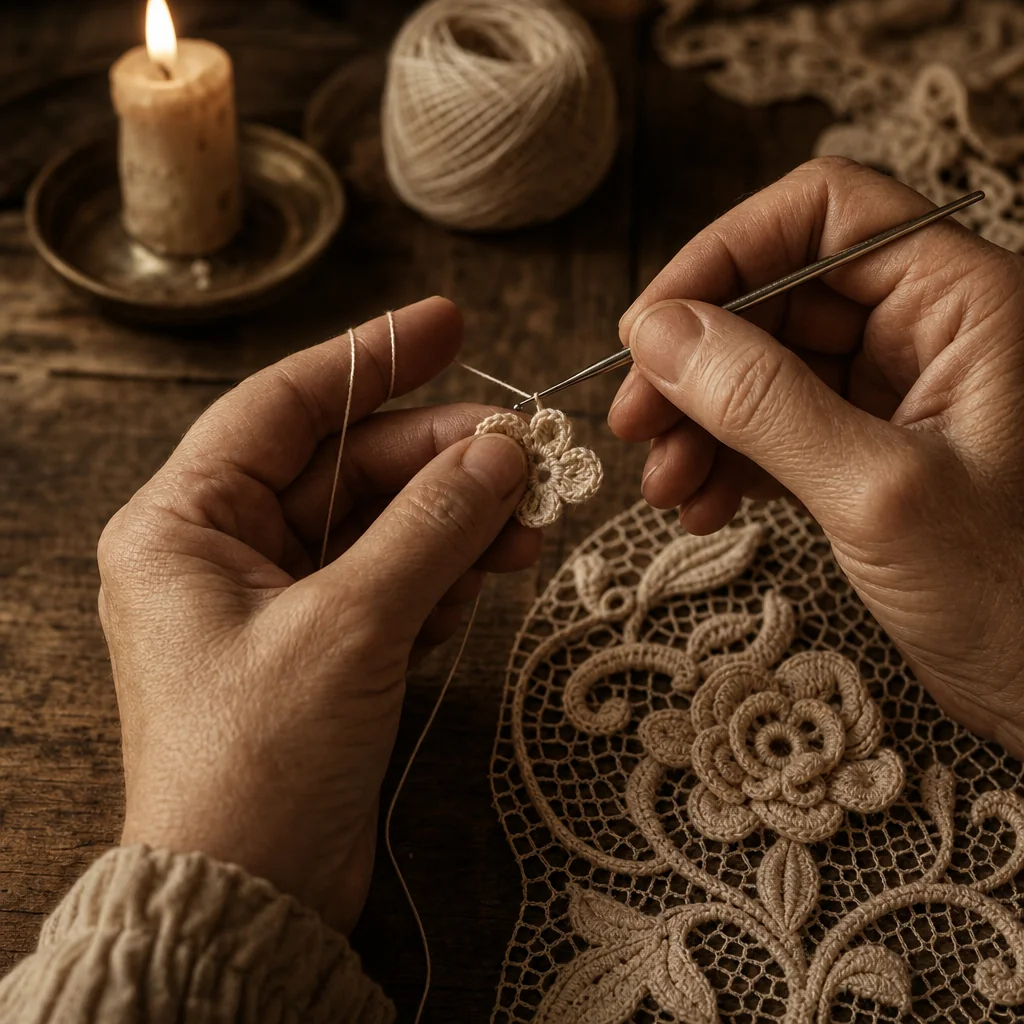
Convent schools and lace-making workshops across Ireland began teaching women and children to crochet intricate motifs using fine cotton thread. The genius of the approach lay in its accessibility. Unlike bobbin lace, which required a pillow, dozens of bobbins, and a stationary workspace, Irish crochet needed only a small steel hook and thread. This portability meant women could work anywhere, in between tending children, cooking meals, or working in the fields.
The Technical Innovation
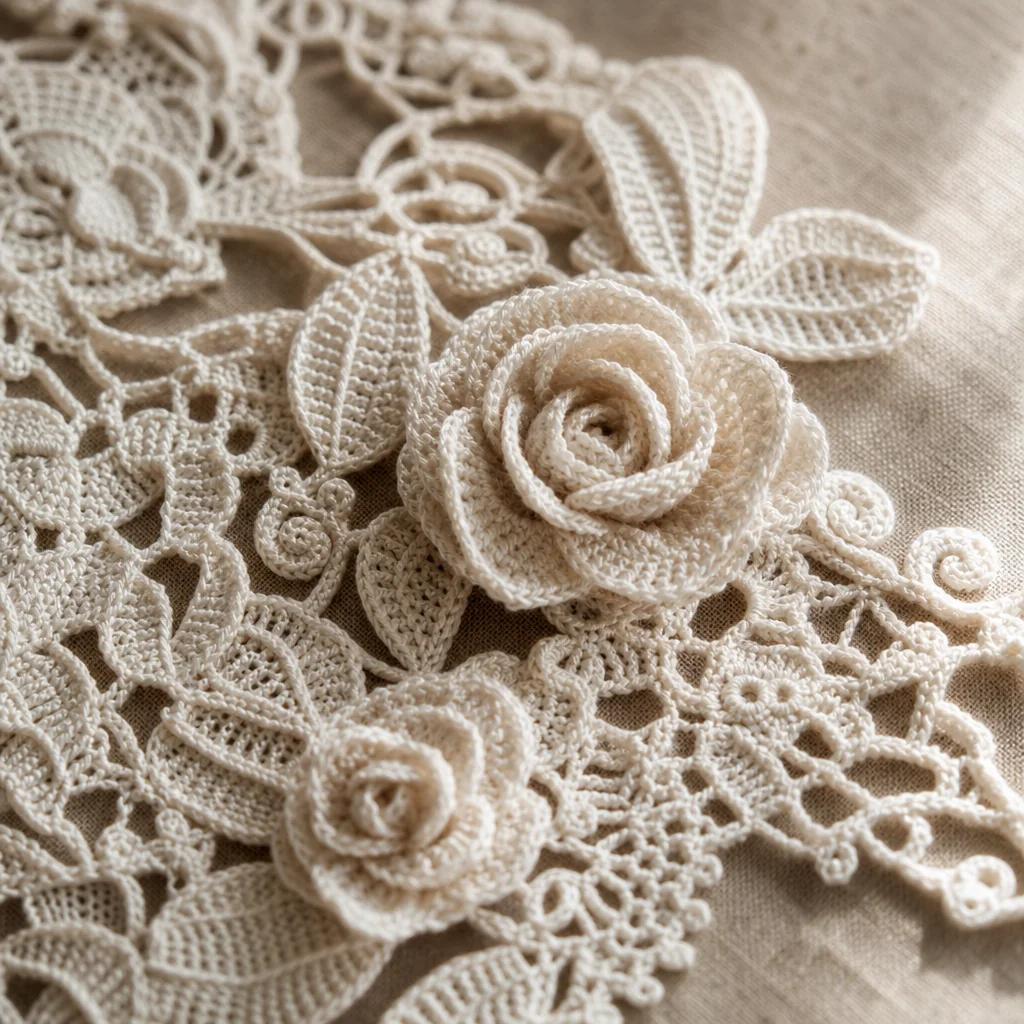
What set Irish crochet lace apart from other crochet forms was its dimensional, sculptural quality. Rather than working in flat rows or rounds, Irish crochet artists created individual three-dimensional motifs, roses with layered petals, shamrocks with raised centers, leaves with visible veins, grape clusters, and delicate flowers, each worked separately and often over a cord or padding to create height and definition.
These motifs were then arranged on a paper pattern and joined together with a delicate mesh background, often worked in variations of chain spaces and picots. The mesh itself became an art form, with different families and regions developing signature background patterns. Some used a simple net ground, while others incorporated elaborate variations with different sized loops and decorative fills.
The modular construction method had practical advantages beyond portability. Multiple family members could work on motifs simultaneously, with the most skilled worker, often the mother or eldest daughter, assembling the final piece and creating the background mesh. This division of labor increased productivity while maintaining quality in the most visible elements.
The thread used was typically fine mercerized cotton, ranging from size 60 to 100, requiring hooks so small they resembled pins. The fineness of the thread contributed to the delicate appearance of the finished lace, but it also demanded exceptional eyesight and dexterity. Children often learned the craft young, when their eyes were sharp and their small fingers nimble.
From Cottage Industry to International Fame
By the 1850s, Irish crochet lace was being exported to England and continental Europe. British relief organizations and philanthropic groups initially promoted the lace as a charitable cause, but its quality soon spoke for itself. Fashion magazines began featuring Irish crochet collars, cuffs, and insertions, and the technique's reputation grew.
The 1870s and 1880s marked the golden age of Irish crochet. European fashion houses, particularly in Paris and Vienna, incorporated Irish lace into haute couture gowns. Queen Victoria herself wore Irish crochet, lending royal approval to the craft. Wedding dresses, christening gowns, blouses, and accessories adorned with Irish crochet became symbols of refinement and taste.
The lace was especially prized for its raised, sculptural quality, which gave garments texture and visual interest that flat laces could not achieve. A single elaborate collar might contain hundreds of individual motifs, each requiring hours of work, joined with meticulous attention to spacing and symmetry.
Irish crochet exports became a significant economic force. Entire villages specialized in the craft, with local schools and convents serving as collection and distribution centers. Women could earn income while remaining at home, a crucial consideration in a society where women's economic opportunities were limited. The craft quite literally kept families alive during and after the famine years.
Regional Variations and Signature Styles
As Irish crochet production spread across the country, regional styles emerged. Clones, in County Monaghan, became particularly famous for its lace, characterized by delicate floral motifs and fine mesh backgrounds. Clones lace often featured roses with tightly rolled centers and radiating petals, a technique still taught in the town today.
Youghal, in County Cork, developed a style that emphasized geometric patterns alongside floral motifs, incorporating more structured elements into the flowing organic forms. Cork lace, more broadly, often featured shamrock motifs as signature elements, celebrating Irish identity through design.
Each production center developed its own pattern books and teaching methods, closely guarded as trade secrets. Master lace-makers could often identify the origin of a piece by examining its motif construction and background mesh patterns, the way an expert might identify a painter's brushwork.
The Decline and Revival
The early 20th century brought challenges to Irish crochet lace production. The rise of machine-made lace offered cheaper alternatives, and changing fashion tastes moved away from the elaborate ornamentation that Irish lace exemplified. The two World Wars disrupted trade routes and shifted economic priorities. By the 1950s, commercial Irish crochet production had largely ceased.
But the craft never truly disappeared. Individual artists continued to practice the technique, and cultural preservation efforts, particularly in Ireland, worked to document and teach traditional methods. Museums and textile collections preserved historical examples, allowing later generations to study the finest work of the past.
The late 20th century saw a revival of interest in Irish crochet, driven partly by the broader fiber arts renaissance and partly by renewed appreciation for handmade, labor-intensive crafts. Contemporary crochet artists began exploring Irish techniques, sometimes faithfully reproducing traditional patterns, other times adapting the dimensional motif approach to modern designs.
Today, Irish crochet occupies a unique position in the crochet world. It is recognized as one of the most technically demanding forms of the craft, requiring patience, fine motor skills, and a deep understanding of three-dimensional construction. While few people make it commercially, those who learn the technique join a tradition that spans over 170 years.
Why Irish Crochet Lace Still Matters
Studying Irish crochet lace offers more than technical skill development. It connects contemporary crocheters to a lineage of artists who worked under extraordinary circumstances, turning thread and hook into both economic survival and genuine artistic expression. The craft emerged from tragedy but produced beauty that still captivates us today.
The techniques developed by Irish lace-makers, working motifs separately, using padding and wire for structure, creating dimensional texture, have influenced countless other crochet styles. Modern freeform crochet, for instance, owes much to the modular, sculptural approach pioneered by Irish artists.
For advanced crocheters looking to challenge themselves, Irish lace offers endless learning opportunities. Each motif type requires slightly different approaches. Roses need careful tension control to create even petals that layer properly. Leaves require strategic increases and decreases to achieve realistic curves. The background mesh demands consistent gauge and an eye for spacing.
Moreover, Irish crochet lace represents a powerful reminder of craft's role in social history. These delicate roses and shamrocks were not mere decorations; they were economic tools that helped families survive, cultural expressions that maintained Irish identity during diaspora, and artistic achievements that earned international recognition. When you work an Irish crochet motif, you touch that history directly.
Many museums and cultural institutions now hold extensive Irish crochet collections, offering opportunities to study historical pieces up close. The Victoria and Albert Museum in London, the Metropolitan Museum of Art in New York, and various Irish museums preserve examples ranging from simple collars to elaborate wedding gowns. Examining these pieces reveals the extraordinary skill of their makers and provides inspiration for contemporary work.
Learning Irish Crochet Today
For crocheters interested in exploring Irish lace techniques, the journey typically begins with mastering basic raised motifs. Simple flowers and leaves provide introduction to the principles of dimensional construction without overwhelming complexity. From there, more elaborate motifs like roses, with their multiple petal layers, or grape clusters with their spherical forms offer progressive challenges.
Historical pattern books, many now in the public domain, provide authentic motif patterns and assembly instructions. Contemporary teachers and pattern designers also offer Irish crochet resources adapted for modern crocheters, often with clearer instructions and photography than vintage sources provided.
The thread requirements deserve consideration. While authentic Irish lace used thread sizes 60-100, beginners often start with size 10 or 20 crochet cotton, which is easier to see and handle while still producing delicate results. Steel hooks in sizes 7-10 (1.65mm-1.30mm) work well for these thread weights.
Patience proves essential. A single rose motif might take an hour or more to complete, and a small doily could require dozens of motifs plus hours of assembly and mesh work. But the results, three-dimensional, delicate, and historically resonant, justify the investment of time.
Irish crochet lace stands as testament to human creativity and resilience. What began as a survival strategy during one of history's worst famines became an internationally celebrated art form that continues to inspire crocheters worldwide. Learning even a few traditional motifs connects you to generations of Irish women who transformed thread into income, art, and cultural legacy.
Next step
Explore Advanced Crochet Techniques