What Is Tunisian Crochet? A Complete Beginner's Guide
by Crochets Studio — A fiber artist specializing in hybrid crochet techniques, I've spent years exploring how Tunisian crochet bridges the gap between knitting and traditional crochet. I teach workshops across Ontario and share techniques that make complex-looking stitches accessible to everyday makers.
Tunisian crochet uses a long hook to create fabric that looks knitted but works like crochet, with a unique two-pass row system. This hybrid technique produces dense, structured fabric perfect for blankets, scarves, and bags. If you love the look of knitting but prefer the simplicity of crochet, Tunisian crochet offers the best of both worlds.
Understanding Tunisian Crochet
Tunisian crochet occupies a unique space in the fiber arts world. While it uses a crochet hook and follows crochet logic, the resulting fabric looks remarkably similar to knitting. This hybrid technique creates dense, textured fabric with minimal curling and excellent stitch definition.
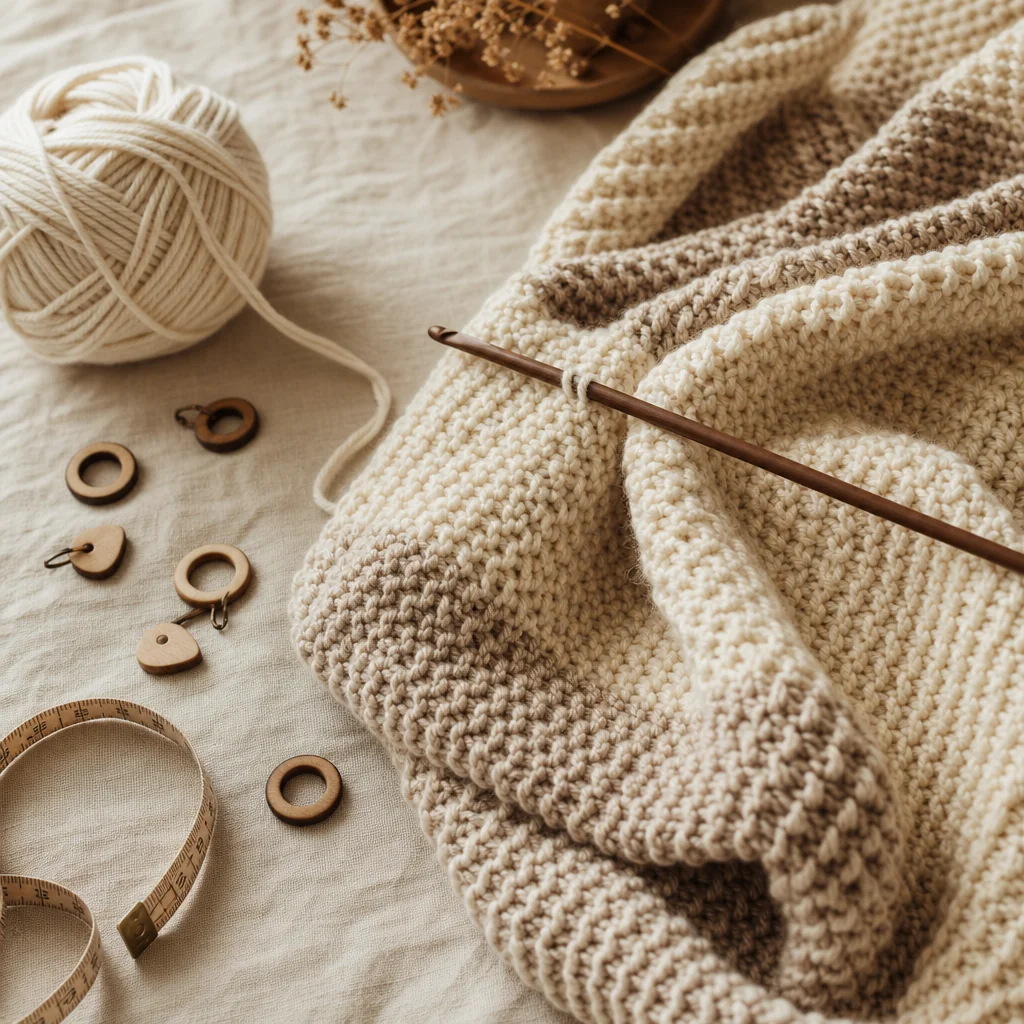
The technique goes by several names: Tunisian crochet, Afghan stitch, tricot crochet, or the shepherd's knitting. Despite the various names, they all refer to the same foundational technique that originated in the Middle East and North Africa before spreading throughout Europe and North America.
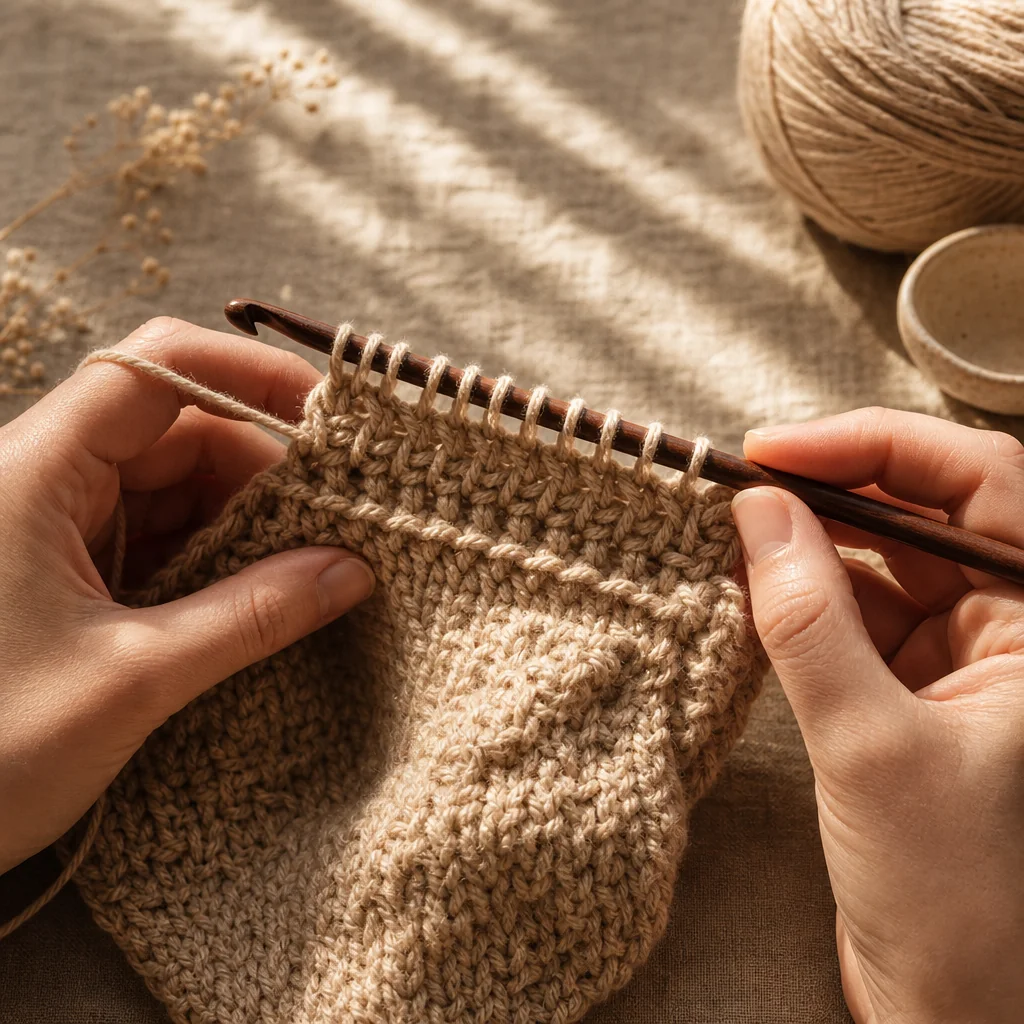
What sets Tunisian crochet apart is its two-pass system. Traditional crochet completes each stitch before moving to the next. Tunisian crochet keeps multiple loops active on your hook at once, similar to knitting, then works them off in a return pass. This creates fabric that's thicker and warmer than standard crochet, with less drape but more structure.
Essential Tools and Materials
The Tunisian Hook
Your most important tool is a Tunisian crochet hook, which looks quite different from a standard crochet hook. These hooks are longer (typically 10-14 inches) to accommodate multiple loops, and they feature a stopper or knob at the end to prevent stitches from sliding off.
Tunisian hooks come in three main styles:
Standard Tunisian hooks work well for small to medium projects like dishcloths, scarves, and baby blankets. The hook length limits your project width to whatever fits on the shaft.
Tunisian hooks with flexible cables attach to interchangeable hook heads, similar to circular knitting needles. These let you work wider projects like afghans and shawls without the awkwardness of a rigid 3-foot hook.
Double-ended Tunisian hooks have a hook at each end and no stopper, allowing you to work Tunisian crochet in the round or create reversible fabric.
Start with a standard Tunisian hook in size H/8 (5mm) or I/9 (5.5mm). These mid-range sizes work well with worsted weight yarn and give you room to learn without cramping your hands.
Choosing Your Yarn
Worsted weight yarn (category 4) is ideal for learning Tunisian crochet. It shows stitch definition clearly, works up quickly, and forgives minor tension issues. Avoid slippery yarns like silk or bamboo while learning, as they make it harder to maintain even tension.
Light colors help you see your stitches clearly as you learn. Save dark or variegated yarns for after you've mastered the basics.
The Two-Pass System Explained
Every row in Tunisian crochet consists of two distinct passes:
Forward Pass (Picking Up Loops)
Working from right to left (or left to right if you're left-handed), you pick up loops across the row. Each loop stays on your hook, building up until you have one loop for each stitch across your work. Your hook will be full of loops at the end of the forward pass.
Return Pass (Working Off Loops)
Without turning your work, you work from left to right (or right to left for lefties), binding off loops until only one loop remains on your hook. This completes the row.
This two-pass system is what creates Tunisian crochet's distinctive texture. The forward pass establishes the vertical bars that characterize the fabric, while the return pass locks them in place.
Learning the Tunisian Simple Stitch (TSS)
The Tunisian Simple Stitch forms the foundation of most Tunisian crochet patterns. Once you master TSS, you can explore countless variations and textures.
Foundation Row
Chain the number of stitches you need, plus one. Insert your hook into the second chain from the hook (not the first chain next to your hook). Pull up a loop and leave it on your hook. Continue across the chain, pulling up one loop in each chain until you reach the end. You'll have the same number of loops on your hook as your starting chain count.
For your first return pass, yarn over and pull through one loop (this creates the edge stitch), then yarn over and pull through two loops. Repeat from * until one loop remains on your hook.
Subsequent Rows
Look at your fabric. You'll see vertical bars running up from the previous row. For the forward pass, skip the first vertical bar (it's your edge stitch), then insert your hook from right to left under the next vertical bar. Pull up a loop and leave it on your hook. Continue across, picking up one loop under each vertical bar.
Work the return pass the same as before: yarn over and pull through one, then yarn over and pull through two across the row.
Repeat these two passes for each row until your piece reaches the desired length.
Common Challenges and Solutions
Fabric Curling
Tunisian crochet fabric naturally curls toward the wrong side, especially along the foundation edge. This is completely normal and happens because the forward pass creates tighter stitches than the return pass.
Solutions:
- Use a slightly larger hook for the return pass
- Block your finished piece by pinning it flat and steaming lightly
- Add a border of traditional single crochet around the edges
- The curl often relaxes after a few rows or after washing
Tight Edges
If your edges pull in and your fabric looks narrower at the top than the bottom, you're likely skipping the last stitch or pulling your edge stitches too tight.
Solutions:
- Count your loops after each forward pass to ensure you haven't lost any
- The last stitch can be tricky to see—look for the loop that sits right next to your edge chain
- Keep your tension relaxed, especially on edge stitches
Uneven Tension
Irregular stitches and fabric that looks loose in some areas and tight in others usually indicates inconsistent tension.
Solutions:
- Focus on pulling each loop up to the same height
- Hold your work consistently throughout each row
- Practice for 15-20 minutes at a time until muscle memory develops
- Consider using a slightly smaller hook if your stitches are very loose
Why Learn Tunisian Crochet?
Warmth and Structure
Tunisian crochet creates thicker fabric than traditional crochet, making it excellent for cold-weather accessories and home goods. The dense weave blocks wind effectively and holds heat well.
Efficient Yarn Usage
While denser than standard crochet, Tunisian crochet uses yarn more efficiently than many knitting techniques. You'll use less yarn than stockinette knitting for the same surface area.
Minimal Curling Compared to Knitting
Stockinette knitting naturally curls at the edges, requiring ribbing or borders to lie flat. Tunisian crochet has less dramatic curling and often blocks flat easily.
Versatile Stitch Library
Once you understand the two-pass system, you can explore dozens of Tunisian stitches. The Tunisian knit stitch mimics stockinette perfectly. The Tunisian purl stitch creates ribbing. Tunisian full stitch produces a thick, textured fabric ideal for potholders and trivets.
Works Well for Colorwork
Tunisian crochet excels at stranded colorwork and mosaic patterns. The vertical bars make it easy to follow charts, and color changes create crisp, clear designs without much complexity.
Project Ideas for Beginners
Start with small, flat projects to build your skills:
Dishcloths let you practice the basic stitch in a manageable size. They're practical, quick to complete, and help you develop even tension.
Scarves give you experience with longer rows while remaining narrow enough for a standard Tunisian hook. The dense fabric creates warm, wind-blocking scarves.
Pot holders showcase how well Tunisian crochet handles heat. The thick, dense fabric provides excellent protection.
Baby blankets work well once you're comfortable with the basics. They're large enough to feel substantial but not so big that they become overwhelming.
Avoid garments until you understand how Tunisian fabric behaves. The reduced drape means you'll need to adjust sizing and shaping compared to traditional crochet patterns.
Taking Your Skills Further
After mastering the Tunisian Simple Stitch, explore these variations:
Tunisian Knit Stitch inserts the hook between vertical bars rather than under them, creating a fabric that looks nearly identical to knitted stockinette.
Tunisian Purl Stitch brings the yarn to the front before picking up each loop, creating a bumpy texture perfect for ribbing and texture patterns.
Tunisian Full Stitch combines elements of both TSS and TKS for an exceptionally thick, warm fabric.
You can also experiment with Tunisian crochet in the round, entrelac (woven-looking blocks), and two-color techniques that create stunning geometric patterns.
Moving Forward with Tunisian Crochet
Tunisian crochet opens up new possibilities in your fiber arts practice. The technique feels meditative once you establish the rhythm, and the resulting fabric has a professional, polished appearance that elevates even simple projects.
Start with one small project to get comfortable with the two-pass system and build your confidence. The learning curve is gentle—most crocheters pick up the basics within an hour or two of practice.
As you develop your Tunisian skills, you'll discover this technique's unique advantages: the warmth of knitting, the simplicity of crochet, and a distinctive texture that stands out in a world of standard stitches.